
PLEATS! Sabine Kaipainen and Bettina Schülke, March 28 – April 6, 2026, KKThun, Thun, Switzerland
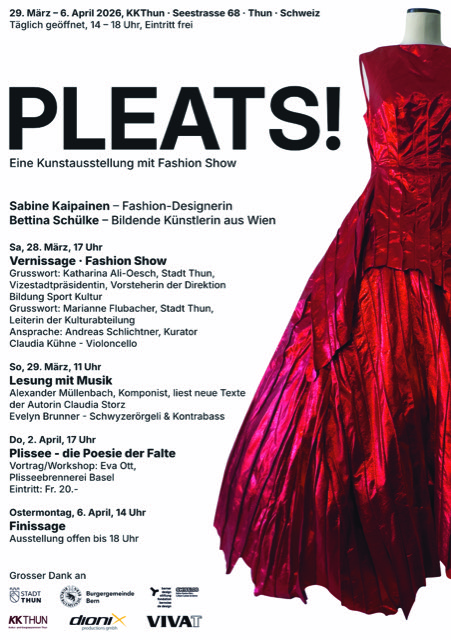
Fotocredit: photo courtesy of Sabine Kaipainen
PLEATS!
Sabine Kaipainen and Bettina Schülke
KK Thun, Switzerland, March 28 – April 6, 2026
Exhibition Text
Andreas Schlichtner
The fold is the central motif of this exhibition.
Sabine Kaipainen, a fashion designer from Switzerland, and Bettina Schülke, a visual artist from Austria, are connected by a long-standing artistic relationship that originated in Finland. Following an intensive engagement and several years of planning, this collaboration now takes concrete form in PLEATS!
Folds / Pleats / Plissés / Folds in Textile Art
Folds are ubiquitous. They run through the histories of art, culture, and humanity and manifest themselves in a wide range of materials, techniques, and contexts. Their aesthetic and functional diversity extends from textile surfaces to architectural structures.
Folds are not merely formal phenomena but bearers of cultural meaning. In their material manifestation, they also bring together apparent opposites such as stability and flexibility, as well as compression and movement. They do not necessarily imply repetition. Each fold can be deliberately set and thereby shapes the overall appearance. As a result of material transformation, they emerge through pressure, heat, or manual manipulation.
Their presence extends far beyond textile art: folds can be found in metal, stone, wood, or concrete, as well as in biological forms—in skin, in geological formations, or in technical applications. Recent research, for example at ETH Zurich, shows that fold-based constructions for concrete formwork can provide innovative solutions for resource-efficient building.
Folds thus constitute a fundamental principle that interweaves aesthetic, material, and cultural dimensions.
Movement and Perception
In the works of Sabine Kaipainen and Bettina Schülke, folds reveal their potential particularly in relation to movement and perception.
Kaipainen’s wearable art responds to the body, follows its movements, and emphasizes or transforms its form. Clothing here becomes a dynamic medium that continuously changes through use. It also unfolds this dynamic quality as a sculpture that can be experienced in the round.
Schülke’s Stereoscopic Textile Images, by contrast, operate within the interplay of space, light, and the position of the viewer. The coloration of the folded textile image-objects shifts as the viewer moves past them and depends on perspective and lighting conditions.
The works thus do not exist as static objects but as relational events in space. Their perception requires movement—it emerges through the interplay of object, space, and viewer and is continuously renewed in each moment.
Folds, Fashion, and Gender Orders
The question of the cultural significance of folds inevitably leads to questions of fashion, embodiment, and gender.
What role do folds play in contemporary clothing practices? Would Western European men wear pleated garments or skirts? And how do cultural belonging and gender identity shape our relationship to clothing?
A look into history shows that such attributions are by no means stable. Emperor Maximilian I, for instance, is depicted wearing a suit of armor with a pleated skirt made of steel—a sign of power and social rank that was clearly coded as masculine. The toga of ancient Rome, as well as ornamental pleated textiles in other cultures, also functioned as visible markers of social order.
The tutu, a pleated skirt made of multiple layers, was brought to Persia in the nineteenth century by Shah Naser ad-Din and temporarily became a widespread garment. This example points to the transcultural circulation of forms and meanings.
Dress codes exist in different forms across all societies. Contemporary explicit regulations—such as those in Iran, but also implicit norms in Western contexts—make clear that clothing and its forms are never neutral. They emerge within dispositifs of power, normativity, and visibility, and shape—often invisibly and through processes of self-regulation—gender roles and spaces of agency.
Dress codes are thus historically mutable, culturally coded systems that both stabilize and can be transformed.
Textile Art and the Canon
The question of the fold ultimately leads to textile art itself and its position within art historical systems of classification.
For a long time, women were denied access to artistic education, which led to textile practices often being situated outside the institutionalized art world. At the Bauhaus, despite its formal commitment to equality, women were systematically directed into specific workshops—particularly weaving. The weaving workshop under the direction of Gunta Stölzl developed into one of the most productive departments, yet remained largely overlooked in art historical reception for a long time.
Conceptual and theoretical constructs reinforced this hierarchy: the distinction between “applied” and “fine” art, as well as art historical categories such as “folk art,” contributed to the classification of textile practices as secondary. The canon of the “fine arts,” as formulated since the late eighteenth century, likewise privileged certain media while marginalizing others.
Recent developments, however, point toward a reassessment. Textile practices are gaining increasing visibility in artistic production, institutional exhibitions, and curatorial contexts.
The exhibition PLEATS! is part of this movement. As a presentation of two artists who employ textile strategies in different ways, it points both to the historical dimension of these practices and to their contemporary potential.
Perceptions of art are the result of cultural constructions and dispositifs—and are therefore subject to change.
Literature references: Lilli Hollein, Mio Wakita, Karina Grömer, Michel Foucault, Verena Krieger, Paul Oksar Kristeller